On June 12, 2026, SpaceX comes to public markets at $135 a share, a valuation near $1.75 trillion and about 107 times sales, among the most expensive equities ever brought to investors. Some of that price is artificial intelligence. Goldman Sachs, the lead underwriter, projects $322 billion of AI revenue in 2030 inside a $474 billion consolidated total, and it published that single segment line with nothing beneath it. The question worth asking before the roadshow talking points harden is not whether to trust the number. It is what the number is built from, and how much of it rides on Grok, the model Elon Musk names most often.

Break the aggregate into its parts and most of it has little to do with how good Grok is.

Start with the one piece that carries a documented price today: compute, which SpaceX earns as a landlord rather than as a model-maker. SpaceX rents capacity on Colossus 1, its original Memphis cluster, to rival labs. Anthropic pays about $1.25 billion a month under terms scoped through May 2029, and Google about $920 million a month from October 2026 through June 2029, each running its own models on SpaceX hardware. Those two contracts alone run near $26 billion a year, and not one dollar of it depends on Grok’s quality. The tenant’s model does the work, and SpaceX collects the rent.

Goldman broke out nothing below its total, so the rest has to be reconstructed from the disclosed contracts and published pricing. Built from the bottom up, the 2030 projection sorts into four blocks. Operational AI, the compute leasing plus the autonomy embedded in vehicles and the network, comes to roughly $92 billion, about 29% of the projection, and depends on Grok not at all. Grok itself, the language-and-reasoning model, comes to roughly $45 billion, about 14%. X-platform advertising adds roughly $12 billion, about 4%. The largest block by far, roughly $173 billion or about 54%, is a pure residual: the gap between what can be built from documented sources and Goldman’s much larger aggregate. Recon Analytics reads that residual as further compute and infrastructure growth, but nothing that we can see documents it, so the conclusion that compute and operational AI dominate the projection holds only if that reading is right. All four sizes are Recon Analytics estimates. Goldman published none of them.

That leaves Grok carrying about a seventh of the projection, roughly $45 billion by 2030, against revenue well under $2 billion in 2025, inside an AI segment the S-1 reports at $3.2 billion that year. The climb the projection assumes, from under $2 billion to $45 billion in four years, is the part of the SpaceX AI story that actually turns on Grok. At about 107 times sales, every dollar of projected revenue carries a steep premium, and the 14% exposed to Grok carries it like the rest.

That climb is not a given, and the people closest to Grok are the reason. Among AI users who name a primary tool, only 1.7% name Grok, and that base is the most male-skewed of any major assistant at 77.2% against 54.2% for the field. They adopt AI at work less than the field does and bring Grok to work least of any major tool, they are the least willing to pay more, naming $6.50 a month to upgrade against $11.70 for Claude’s users, and they name bias a concern most often, at 23.0% against 13.5% for the field. A revenue line built to reach $45 billion has to convert a base that is, for now, the hardest of the majors to convert. The counterweight sits in the same data. Grok’s accuracy rating climbed from clearly negative into positive territory in April and May 2026, and the users who already pay report good value for the money. That is early, directional evidence that the rebuild Musk describes may be reaching the product, even as the trust and bias gaps have not moved.

So the disaggregation points an investor toward a cleaner way to price the AI line. Pay for what Grok does today, which is real but modest: bounded jobs across X, Tesla, Starlink support, and SpaceX’s own engineering, none of them in a loop where a wrong answer costs a life or a mission. Then treat the run to $45 billion as an option on a rebuild that Musk says is underway, priced as a probability rather than a promise. Most of the $322 billion is landlord compute and operational autonomy that will earn or fail to earn on their own merits no matter what happens to Grok.

One sensitivity sits above the others, and it cuts the other way. The Anthropic and Google leases carry 90-day cancellation clauses, and Musk has described the Anthropic arrangement in public as limited to six months, which sits in tension with the headline term running to 2029. If those leases shorten, the operational base that anchors this whole reconstruction shrinks with them. That is the single largest swing in the picture, and it works against the compute revenue, not against Grok.

What to watch from here is narrow. During and after the roadshow, listen for what SpaceX and Musk claim about Grok’s role inside that AI number, because the gap between Grok’s small current revenue and the large role the selling story implies for it is the whole tension. Watch whether the compute leases hold their headline terms or shrink toward Musk’s six-month characterization. And watch whether the rebuild produces a materially better model rather than a better name. Price the parts, not the headline, and most of SpaceX’s AI number sits clear of Grok.

Source: Recon Analytics AI Pulse, US named-primary AI users, March through May 2026 (Grok n=744; field n=44,541).

Continue Reading
Access the full premium research report
View the executive overview, full table of contents, analyst insights, and purchase options for the complete PDF report.

Read the Full Report →

The simple story about wireless is a price war: multi-year price locks, free lines, cable carriers underselling the mobile network operators and fixed wireless exceeding everyone’s expectations. A more complex story is revealed by the MNOs detailed earnings results. The core price of connectivity has been flat for nearly four years while household income has increased. Net net? The carriers turned themselves into discount storefronts for the services they sell.

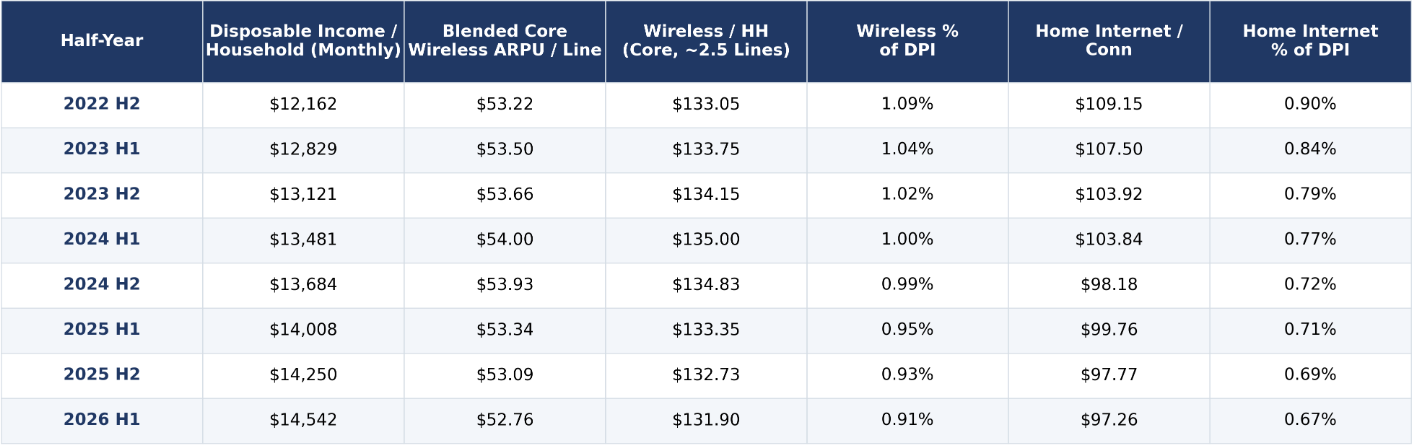
Reported wireless revenue per line looks like it climbed. Blended across AT&T, T-Mobile, and Verizon, postpaid phone ARPU rose from $53.22 in the second half of 2022 to $56.37 in early 2026, a roughly 6% rise. But Verizon, the carrier driving most of the 6% increase books streaming and cloud perks inside its reported ARPU. Its former consumer chief revenue officer stated publicly in March 2025 that 15% of wireless service revenue now comes from non-connectivity services, a figure that was zero when myPlan launched in May 2023 and is closer to 17% today. Strip the perks out on the same ramp, and the picture inverts. Blended core connectivity ARPU went from $53.22 to $52.76, flat to slightly down in nominal dollars across three and a half years.

Meanwhile, nominal disposable income per household climbed about 19% in the last four years according to the US government’s Bureau of Economic Analysis. Flat price, rising income, and the math is easy to understand.

Wireless is carrier-reported core ARPU (Verizon perk-adjusted). BEA NIPA per-capita nominal disposable personal income (series A229RC), scaled to household; real-terms adjustment uses the BEA DPI deflator (A229RC/A229RX); October 2025 onward extrapolated

Wireless fell from 1.09% of household disposable income to 0.91%, a 17% reduction in the relative burden, while the core price per line did not rise at all. That is the paradox in one line: ARPU went up, the price of connectivity did not, and telecom claimed less of the wallet driving real world savings for American families.

In real terms the gap is starker. Over the period the disposable-income price level rose about 9%, so a household’s real purchasing power grew roughly 9% rather than the full 19% nominal, while the core price of wireless, flat in nominal dollars, fell about 10% after inflation. The device is the one place inflation barely matters: the climb in smartphone selling prices is mostly premiumization, real buyers choosing more expensive phones, not the dollar losing value, with carriers footing for most Americans. Inflation-adjusted, connectivity got cheaper, incomes got larger, and only the hardware the consumer chose to upgrade got pricier.

While prices remained steady in the last several years, the value consumers are taking from their wireless providers has dramatically increased. Let’s look at Verizon by way of example.

Verizon is the lone nationwide carrier that books its perks into reported service revenue, about $10.50 per line by 2026, which is why Verizon alone takes the perk adjustment in the numbers above. The perks represent significant savings: Netflix and Max for $10 against roughly $18 bought separately, Apple One and Google One at about half of their near-$20 retail.

T-Mobile and AT&T deliver streaming without increasing their ARPU at all. T-Mobile folds Netflix into the plan and gives it away, and the Apple TV+ that shows up at $3 on a T-Mobile bill is passed straight through to Apple, not booked as T-Mobile service revenue. So two of the three nationwide carriers were already at clean core connectivity pricing, and only Verizon’s apparent climb was perks. The industry turned itself into a half-price, often free, storefront for streaming and cloud while holding the price of the pipe flat.

The value consumers are getting on the device side has increased as well. Consider the following. Recon Analytics Device Intelligence shows the sellout-weighted average selling price of a US smartphone reached $738 across 2025 and peaked at $868 in the fourth quarter, the iPhone 17 launch window, up from roughly $615 a year earlier. Forty percent of phones sold in 2025 cost $800 or more, and nearly one in five was a $999-and-up flagship. The market has finished its move to 5G: 93% of phones bought in 2025 were 5G-capable, so the network the carriers spent years building now sits in nearly every new device. Apple accounts for 57% of US units sold at an $884 average, Google’s Pixel tops the range at $992, Samsung holds a quarter of the market at $652, and Motorola anchors the value end at $285. consumers have access to better devices while the carrier absorbs the cost.

Nearly one in five phones sold still costs under $300, so the household that wants to spend less can, while carrier trade-in credits and multi-year interest-free financing put the $884 Apple within monthly reach for the household that wants the best.

For the American consumer, all of this adds up to one of the best deals in the household budget.

Wireless service runs about $130 a month for a typical multi-line household and has been flat in nominal terms since 2022, under 1% of disposable income and falling about 10% in real terms. For that, plus a device financed at zero interest with carrier generally crediting back the financing cost, the household carries a premium 5G phone whose $700-plus sticker it never felt, multi-year price certainty, and a stack of streaming and cloud services worth $25 to $45 a month at retail for a fraction of that or nothing. A family that would pay $40 to $50 assembling Netflix, a second streamer, and cloud storage on the open market gets the same through the carrier for $10 to $20, or free on T-Mobile. Connectivity is cheaper as a share of income than at almost any point in the smartphone age, the rising cost of the device is absorbed by the carrier, and the services that ride the network arrive at half price or no price.

The competitive read inverts the conventional wisdom. This was not a race to the bottom on price. Carriers held core connectivity prices flat for four years and grew revenue by selling discounted services the customer wanted, while the affordability cushion underneath quietly widened. Wireless now sits below 1% of household disposable income. At that level, a price increase is closer to noise in the family budget than the switching trigger it was when wireless approached 1.4%. The pricing power is real and underused, and the next dollar of revenue is far more likely to come from perks, premium tiers, and device economics than from the base plan. The strategic question is no longer how low the bill must go. It is how much value carriers can stack on a bill that already claims less of the paycheck than at almost any point in the smartphone age.

Continue Reading
Access the full premium research report
View the executive overview, full table of contents, analyst insights, and purchase options for the complete PDF report.

Read the Full Report →

The Question

In February 2026, OpenAI became the first major AI assistant to show ads to free users of ChatGPT. By March, the rollout had expanded to pilot markets in Canada, Australia, and New Zealand. The conventional read is that consumer AI is simply following the path of free email, free search, free social media, and free streaming: founders resist ads on principle, costs grow, and eventually they give in. Anthropic’s pledge to keep Claude ad-free, in this view, is Reed Hastings’ 2020 promise that Netflix would never need ads, a statement that aged poorly.

Our view differs. Ads will produce real revenue at OpenAI. But they will not drive the long-term growth of consumer AI. They will sit alongside it. This note explains why, and what it means for the three major players.

The Core Finding: The Free Tier Is Two Very Different Groups

Recon Analytics runs a monthly consumer survey of AI users in the United States, with tens of thousands of respondents monthly and data running from March 2025 through the present. The survey captures usage frequency, payment status, willingness to pay, and reasons for not paying, with enough sample to draw reliable conclusions across platform, income, and age segments.

The standard story treats free-tier users as one group to be monetized through ads. The data shows they are not.

Usage Segment Avg. WTP ($/mo.) Would Never Pay
Heavy users (multiple times/day) $11.80 18%
Casual users (few times/month) $4.92 38%

Source: Recon Analytics AI Pulse consumer survey, ChatGPT primary users on free tier, 2026 YTD, n=24,984.

Heavy users are economically a different population. They are not casual users who happen to open the app more often. The gap holds at every income level, across every age group from young adults to people in their late fifties, and across all five quarters of data, including the quarter in which the ad rollout launched.

The gap widens among higher-income households. Among users in $100K+ households, heavy free users report willingness to pay of $15.17 per month; casual users in the same bracket report $5.09. That is a 3x spread in the segment that should, by any reasonable theory, be most willing to pay overall.

The Strategic Problem with Ads

This matters because of where ads land. Ads are visible to all free users. The casual users see ads and stay casual, because nothing in their behavior suggests they were ever close to converting to paid. The heavy users see ads and bump up against friction in their main daily tool, at exactly the moment they were most likely to consider paying $20 a month to make it stop.

Ads generate inventory from the group that drives almost none of the cost. The friction lands on the group that drives most of the cost and was most ready to convert. The ad strategy monetizes the wrong half.

The trend data makes this more concerning. Heavy free users have been stable: between 13 and 18 percent say they would never pay, and the number has not moved since the ad launch. Casual free users are drifting in the wrong direction. In Q2 2025, 28.8 percent said they would never pay; by Q2 2026, that number was 36.8 percent. The group ads are aimed at is becoming structurally less convertible over time.

Platform Comparison: Not All Free Tiers Are Equal

The same logic applies to the other major AI assistants, with important structural differences.

Platform “Would Never Pay” (Free Users) Paid Retention (6-Mo.)
Claude ~22% 74%
ChatGPT ~24% 71%
Perplexity ~32% 74%*
Gemini ~37% 74%
Copilot ~39% 92%

Source: Recon Analytics AI Pulse consumer survey, 2026 YTD. Total n=43,738 (free tier); total paid n=11,965. Perplexity paid retention (n=169) is directional only.

The split between the top three and the bottom two is not random. Claude, ChatGPT, and Perplexity users mostly sought the product out. Gemini and Copilot users mostly arrived through distribution: Android devices, Google Workspace, Microsoft 365 enterprise licenses. Deliberate-choice users filter themselves on wanting the product before they ever sign up. Arrived-by-default users include a large fraction who would never have chosen the product actively.

Copilot’s 92 percent paid retention is not a subscriber satisfaction story. It reflects that most Copilot paid users are on enterprise Microsoft 365 licenses they cannot cancel individually. This is a good business for Microsoft. It is a structurally different business from what OpenAI and Anthropic are running, and modeling them as equivalent competitors produces misleading conclusions.

Three Predictions for the Next 18 Months

OpenAI. Ad revenue will scale. Published estimates of a $25 billion annual run-rate by 2030 are plausible, with a 2027 run-rate in the $4 to $8 billion range. But paid subscriber share, currently around 23 percent in our data, will not improve materially. It will stay between 20 and 26 percent through the end of 2027. Ads produce a separate revenue line. They do not pull conversion higher.

Anthropic. Claude’s free users currently convert to paid at roughly 43 percent, nearly double the ChatGPT rate. That gap will narrow as the base grows, because the current user base skews toward self-selected early adopters who are unusually likely to pay. But the gap will not close. Claude should still be converting at least 10 percentage points ahead of ChatGPT by end of 2027. Claude’s paid subscriber base, which has been growing roughly 2.5x every five months through early 2026, will be 2 to 4 times its current level by Q4 2027. The ad-free positioning is working as a business strategy, not just a marketing slogan.

Google. Gemini will carry ads inside the standalone app before the end of 2027. When consumer AI revenue is fully disaggregated, standalone Gemini subscriptions will be a smaller fraction of the total than commonly assumed. Most of what gets reported as “Gemini consumer monetization” is Google One bundle revenue and AI Mode search advertising. Gemini’s economics make sense modeled against Copilot, not against ChatGPT. The one thing Google I/O 2026 adds to this picture: the agentic commerce layer opens a revenue path that bypasses the subscription question entirely, which could make Google’s consumer AI economics work even if conversion stays low.

The Bottom Line

Ads will not solve the core economic challenge of consumer AI. The challenge is converting heavy free users into paying subscribers fast enough to cover the very high cost of serving them. Ads charge friction on the users who drive the cost and were most ready to pay. They extract small revenue from the users who drive little cost and would never have paid anyway.

The companies best positioned to win the consumer AI category are not the ones with the cleverest ad products. They are the ones that figure out how to convert heavy free users into paid subscribers at a higher rate. Anthropic is currently doing this at nearly double the ChatGPT rate, on a smaller base. Whether that advantage holds as the base scales is the most important question in consumer AI monetization over the next 18 months.

For the full analysis including counter-arguments and detailed breakdowns by income and age cohort, see The Wrong Half: Why Ads Will Not Fix Consumer AI’s Money Problem, Recon Analytics, May 2026.

Source: Recon Analytics AI Pulse consumer survey, periods March 2025 to April 2026.

Continue Reading
Access the full premium research report
View the executive overview, full table of contents, analyst insights, and purchase options for the complete PDF report.

Read the Full Report →

In one week in mid-May 2026, three events reshaped the analytical surface in US wireless. On May 12, the FCC approved SpaceX’s purchase of 65 megahertz of nationwide Direct-to-Device spectrum from EchoStar under tech-neutral performance obligations, replacing the December 14, 2026 buildout cliff with a continuous performance standard. Four days later, AT&T, T-Mobile, and Verizon announced a satellite Direct-to-Device joint venture in principle. The announcement carried no name, no spectrum allocation, no governance structure, no capital commitment, and no launch date. A week after that, SpaceX filed its Form S-1, the document the IPO market will use to price the integrated platform across the next several quarters. The S-1 positions SpaceX as the global satellite wholesale supplier to mobile network operator partners. The operating pattern points somewhere else.

The Seven Pieces

Between February 2024 and May 12, 2026, SpaceX assembled seven operating pieces of a US consumer mobile capability that no wholesale supplier needs.

Spectrum: 65 megahertz of nationwide allocation (15 MHz AWS-3 unpaired, 40 MHz AWS-4, 10 MHz PCS H-Block) dedicated to Direct-to-Device, under technologically neutral performance obligations that allow terrestrial, space-based, or hybrid deployment.

Power: a 770 percent power increase from the FCC’s March 2025 waiver, enabling Direct-to-Cell to carry T-Satellite messaging at the July 2025 commercial launch and full data plus WhatsApp voice and video at the October 2025 expansion.

Capacity: the April 30, 2026 NGSO spectrum-sharing overhaul allows up to eight satellites simultaneously per area-and-frequency cell against the prior limit of one. Chairman Carr’s read is up to a 700 percent capacity boost for LEO broadband.

Satellite count: 7,500 additional Direct-to-Cell Gen2 satellites approved in January 2026 under a 15,000-satellite filing, independent of the legacy Starlink internet constellation and purpose-built for cellular use under the elevated power regime.

Brand: USPTO trademark applications for “Starlink Mobile” and “Powered by Starlink,” filed October 16, 2025, covering consumer cellular on the face of the application.

Network identity: ITU-T E.212 records SpaceX as the assigned operator of MCC 901 MNC 08, effective February 1, 2024. A SIM provisioned for SpaceX would see SpaceX as a registered Public Land Mobile Network in the device’s network-selection menu.

Gen2 platform: the deployment platform for the 3GPP 5G non-terrestrial network standard, reaching consumer-grade operationalization across 2027 and converting Direct-to-Cell from a data-and-messaging overlay into native cellular voice at consumer scale on the platform SpaceX controls.

The wholesale-supplier model needs satellites and capacity. The MNO destination needs all seven.

The Pattern Argument

The S-1 commits to expanding the global MNO partnership network, deploying V2 Mobile satellites in 2027, closing the EchoStar spectrum acquisition in November 2027, and achieving 5G non-terrestrial network compliance for unmodified devices through MNO partner pressure on handset manufacturers. It does not commit to becoming a US consumer MNO. The growth-strategy language describes “providing connectivity for everyone” through partnership expansion. The risk-factor section names an option: “either by operating on spectrum leased to us by MNO partners or by utilizing our own domestic spectrum holdings.” The option is preserved on the page. The commercial strategy is wholesale.

The operating pattern reads differently. Strip a $50-per-month US wireless subscription to its inputs. The gap between ARPU and the cost to provide service is larger than five times. The two-decade pattern across rockets, batteries, AI compute, and satellite manufacturing reads that gap as organizational waste and attacks it with a vertically integrated build. SpaceX has not signed an MVNO agreement anywhere in the world; the thirty international MNO partnerships are the inverse arrangement, with SpaceX as the upstream supplier. T-Mobile’s T-Satellite in the US is the same template. The wholesale-supplier model is what SpaceX has been running, not what the documented pattern points toward over the three-year IPO-priced optionality horizon.

The Carrier Signal

The carriers read the pattern. The May 16 joint-venture announcement arrived inside the 96-hour window between the FCC approval and the SpaceX IPO disclosure cycle opening. Five attributes diagnose its purpose: no name, no spectrum allocation, no governance structure, no launch date, and explicit preservation of each carrier’s bilateral satellite relationships. T-Mobile keeps T-Satellite with Starlink. AT&T keeps its AST SpaceMobile partnership and adds the new EchoStar-Boost MVNO. Verizon keeps its AST SpaceMobile commercial agreement signed October 8, 2025. The JV pools nothing operational. It is a position-marker placed before the strategic response had been negotiated.

The market initially treated the JV as a defensive moat against SpaceX. A sharper diagnosis: the JV is the carriers’ alarm signal at SpaceX’s growing market power in satellite telecom, expressed in announcement form before the strategic response had been articulated. The S-1 does not disclose the direct-MNO commitment the carriers are reacting to. The carriers are reading the operating pattern, not the disclosure document. They are reading correctly.

The Funding Architecture

The IPO funding architecture has a feature that prior reports could only sketch. The S-1 confirms total EchoStar consideration of approximately $19.6 billion, comprising approximately $11.1 billion in equity (261.8 million shares at $42.40 per share) plus up to $8.5 billion to pay off designated EchoStar debt. The SpaceX Bridge Loan signed March 2, 2026 was used to repay X and xAI notes following the February 2026 SpaceX-xAI merger, and requires repayment from net IPO proceeds. The IPO is therefore part debt-refinancing event and part growth-capital raise. The mix matters for what the proceeds actually fund.

The Anthropic compute partnership announced May 6, 2026 covers Colossus 1 at more than 300 megawatts and more than 220,000 NVIDIA GPUs, analyst-reported at roughly $5 billion annually. The Connectivity segment generated $7.2 billion in Segment Adjusted EBITDA in 2025, nearly double 2024, with Starlink Subscribers at 10.3 million by Q1 2026, up 105 percent year-over-year. The broadband engine funds the integrated capital plan regardless of how mobile activation lands.

Two Paths to MNO

The platform reaches the MNO destination on either of two paths.

The host path: a nationwide MNO agrees to host Starlink Mobile on wholesale terms. The carrier is the invisible network underneath; the customer-facing brand is Starlink. The case is structurally real but commercially constrained on every side. Each nationwide MNO already carries at least one bilateral satellite counterparty commitment, and the cost of breaching or renegotiating an AST commercial agreement raises the threshold for a host move at AT&T and at Verizon. The base-case read is that none of the three breaks inside the IPO disclosure window.

The direct path: SpaceX builds the terrestrial fill itself. AWS-4 second-step assignment closes November 30, 2027 and SpaceX takes direct operational control of the spectrum. 5G non-terrestrial network consumer-grade operationalization on Gen2 satellite hardware in 2027 lights up native cellular voice on SpaceX-controlled spectrum. The engineering layer reaches commercial scale in late 2027 to early 2028. The institutional-knowledge layer (state-by-state PUC compliance, lawful intercept architecture, E911 service-level architecture, port-in coordination, customer support at scale) ramps on its own clock for an additional 12 to 24 months. The realistic operational read for consumer scale is 2029 to 2030, not 2028. The IPO market prices the destination at the headline; the post-IPO trading window prices the institutional layer at the discount.

What to Watch

Three observable events between July 2026 and Q1 2028 falsify the direct-MNO thesis. First, if SpaceX’s X-channel statements through Q3 2026 sustain the wholesale-supplier framing rather than re-frame the carrier denials as bad-faith obstruction. Second, if the T-Satellite exclusivity expiry on July 23, 2026 lands as a quiet termination with no SpaceX-side renegotiation drama. Third, if the November 30, 2027 AWS-4 second-step assignment closes and is followed within ninety days by a public SpaceX commitment to wholesale-lease the spectrum rather than to direct deployment. Two of three observed compress the direct path’s probability materially. All three convert the pattern thesis from direct-MNO-with-wholesale-transition to wholesale-with-optionality as the durable end state.

The IPO disclosure window opens in June 2026. The road show prices what the S-1 says. The post-IPO trading cycles will price what the operating pattern is committed to. The S-1 says wholesale. The pattern says MNO.

Continue Reading
Access the full premium research report
View the executive overview, full table of contents, analyst insights, and purchase options for the complete PDF report.

Read the Full Report →

May 2026

Satellite internet used to mean one thing in the business world: a slow, expensive connection of last resort when nothing else was available. HughesNet and Viasat filled that role for years, and nobody was excited about it. LEO satellite operators, including Starlink, have changed that story. Lower latency, faster speeds, and a product that can actually compete with fixed wireless have moved satellite from the back of the options list to a legitimate part of businesses’ connectivity fabric. However, even with greater acceptance of LEO satellite communications, Starlink still has a limited market position.

The Coverage Gap Story

The strongest direct sales case for Starlink in business markets is the coverage gap. Go where the competition does not. It sounds simple, and in a lot of ways it is.

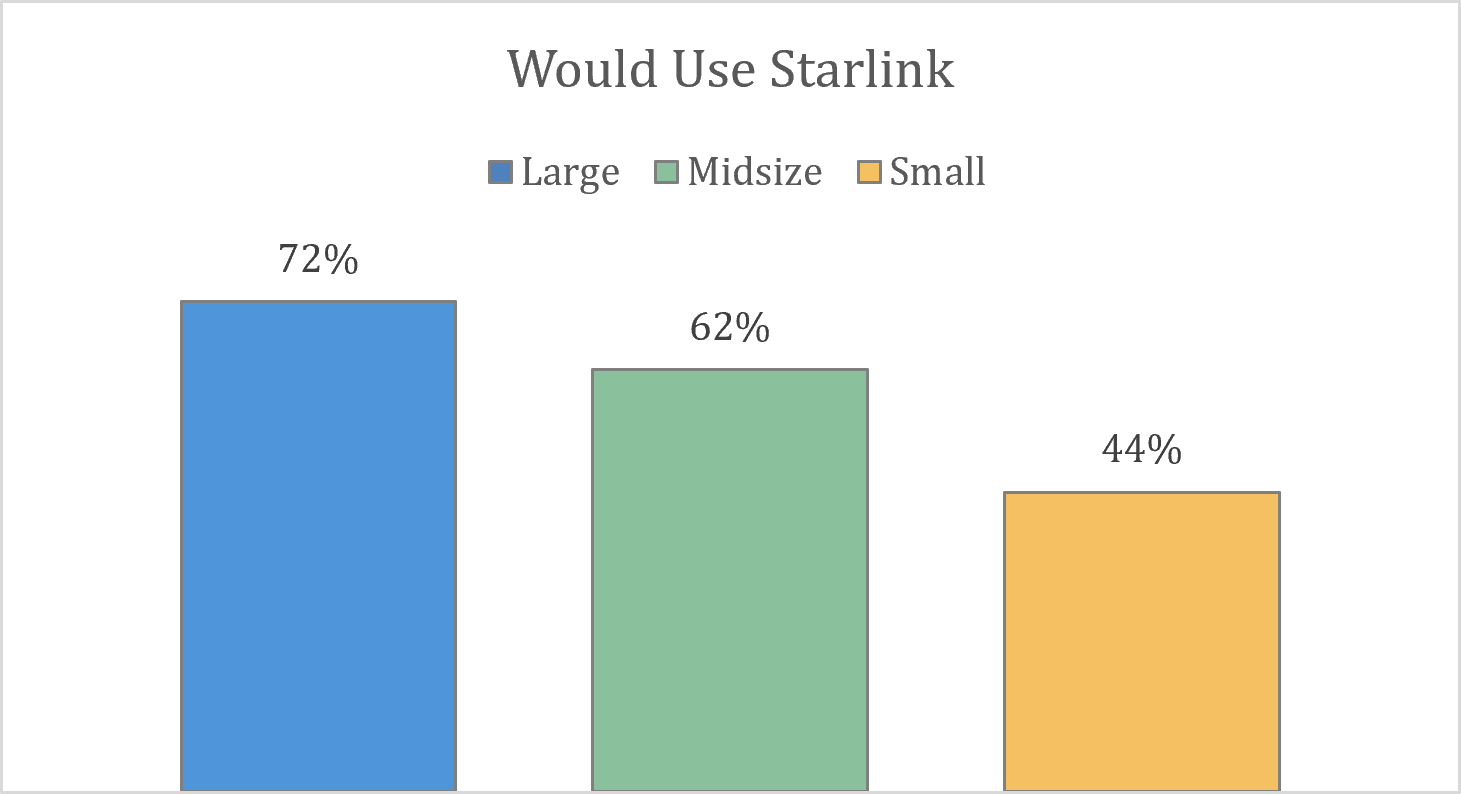
Between March 4 and April 7, 2026, we asked businesses whether they would work with a smaller ISP if that ISP could deliver Starlink connectivity in places where they currently had no coverage (Large n=586, Midsize n=455, Small n=554). Large businesses came in at 72%, midsize at 62%, and small businesses at 44%. The 28-point spread between large and small is the part worth paying attention to. Large businesses are most receptive because they are most likely to already be living with this problem. A company with 50 locations almost certainly has some of those locations sitting outside fiber and cable reach. A small business with one rural location either has the problem or it does not. For the large enterprise managing a dispersed footprint, a Starlink-augmented ISP solves something concrete and immediate.

Figure 1. Percent of Respondents Who Would Work with a Smaller ISP if They Augmented Coverage with Starlink

Source: Recon Analytics 3/4/2026-4/7/2026, Large n = 586, Midsize n = 455, Small n = 554

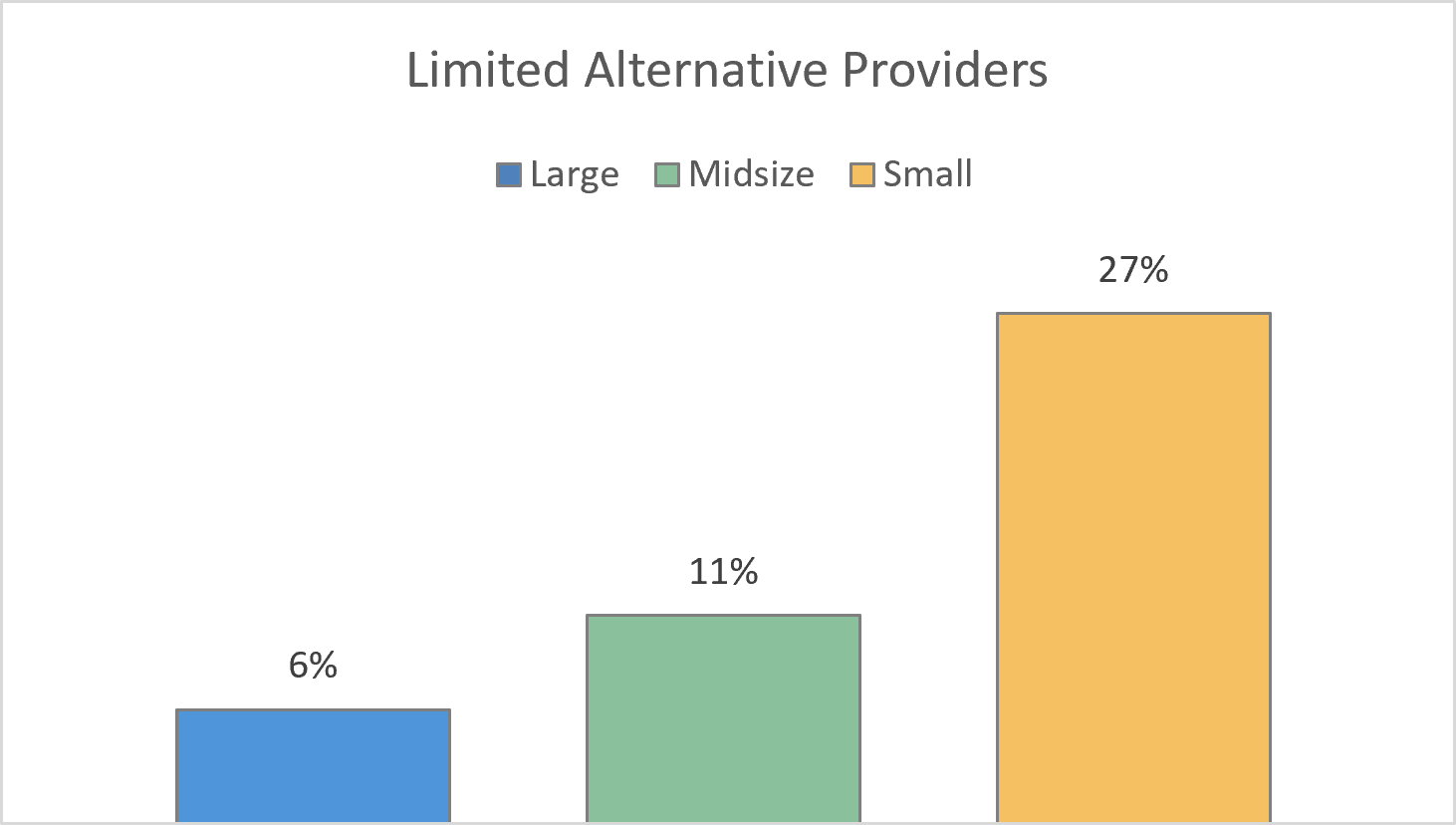
The second piece of data that helps to illustrate the coverage gap opportunity for Starlink comes from a different question. Between November 5, 2025, and May 6, 2026, we surveyed 9,913 businesses and found 1,483 that were unhappy with their current internet provider but had not switched. Among small businesses in that group, 27% said the reason they had not left was simple: there were no other options. For midsize businesses it was 11%, and for large businesses just 6%.

That 27% small-business figure is where Starlink’s direct-sales pitch is at its strongest. When a business is stuck with a provider they dislike because there is literally nothing else, Starlink is not going head to head with a well-resourced competitor. It is filling a gap that nobody else is filling. That is a very different conversation.

Figure 2. Limited Alternative Internet Provider as Reason to Stay with Current Provider

Source: Recon Analytics 11/5/2025-5/6/2026, Large n = 361, Midsize n = 502, Small n = 620

Moving outside of areas with little to no broadband access will be more difficult for Starlink as larger businesses do not just buy connectivity from their ISPs. Larger businesses buy a full suite of solutions including security, direct cloud connectivity, and SD-WAN. These are all services that Starlink does not provide. Starlink, currently, just provides connectivity.

The FWA Backup Case

The satellite-as-backup to primary internet access is Starlink’s other major business connectivity opportunity. Starlink does not need to win the primary internet relationship here. It just needs to be there when the primary connection goes down.

AT&T and Verizon already do something similar with FWA. Both service providers use their FWA network as a failover solution incase the primary internet access line they provide should have an outage. Satellite can provide the same function in areas where FWA is not available or where FWA is the primary access technology.

Recon Analytics tested this concept directly with U.S. businesses during the first half of 2026. Between April 1 and April 29, 2026, we asked businesses whether satellite backup would make FWA a more attractive primary connection (Large n=525, Midsize n=464, Small n=563). Large and midsize businesses both came in at 34%. Small businesses were at 24%. These numbers predate T-Mobile’s SuperBroadband announcement in May 2026, which matters. Starlink failover is one of key features of SuperBroadband. This is demand that existed before the product launched, not demand manufactured by a marketing push.

The practical reality, though, is that the FWA backup opportunity mostly runs through carriers, not through Starlink’s direct sales team. T-Mobile owns the customer relationship in SuperBroadband. Comcast Business owns it in its managed connectivity offering which utilizes Starlink as well. That is a lower-margin model than selling direct, and it means accepting a role as infrastructure provider rather than service provider. The upside is scale. Carrier channels can reach enterprise accounts and multi-location businesses that Starlink cannot do as efficiently on its own.

The longer-term question for Starlink is whether it stays in that infrastructure role or eventually moves to compete directly in markets where carrier partners currently hold the customer. Nothing in Starlink’s commercial agreements with T-Mobile or Comcast prevents it from doing so. The constraint right now is product fit, not contract language. That distinction is worth keeping in mind when thinking about how durable these partnerships really are. The recently announced joint venture between AT&T, T-Mobile, and Verizon on direct-to-device satellite communications could complicate Starlink’s relationship with T-Mobile and be a catalyst for Starlink to take a more aggressive role in selling directly to businesses.

Continue Reading
Access the full premium research report
View the executive overview, full table of contents, analyst insights, and purchase options for the complete PDF report.

Read the Full Report →

Apple gained 6.3 points in installed-base share among 18-to-29-year-old US smartphone users from Q3 2025 to Q1 2026. Exclusive loyalty in the same cohort is 12.3 percent, 23 points below the 60-plus reading.

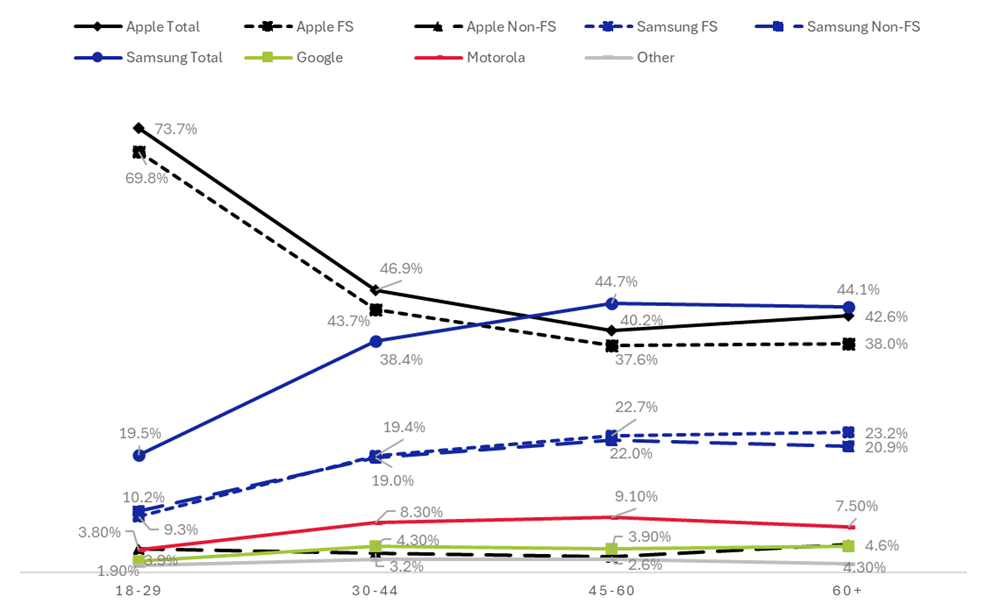
In the US smartphone installed base, Apple commands the 18-to-29 cohort at 73.7 percent share across the combined Q3 2025 to Q1 2026 window, more than three times Samsung’s combined 19.5 percent. Behind that combined reading, the trend is also moving in Apple’s favor. Apple’s 18-to-29 share rose from 68.9 percent in Q3 2025 to 75.2 percent in Q1 2026, a 6.3-point gain in nine months that is well above the margin of error.

Table 1: Apple 18-to-29 Installed-Base Share by Quarter
Quarter Apple Share Samsung Flagship Share
Q3 2025 68.9% 11.3%
Q4 2025 76.3% 7.9%
Q1 2026 75.2% 9.1%
Combined 73.7% 9.3%
Source: Recon Analytics Consumer Pulse Survey, Q3 2025 through Q1 2026, smartphone-only

The data come from Recon Analytics’ Consumer Pulse Survey, covering 248,279 US smartphone respondents tracked from Q3 2025 through Q1 2026, with respondents’ device brand and model identified via passive detection at survey entry rather than self-report. Apple’s installed base is 93.2 percent in the premium tier and 6.8 percent in the value tier. Samsung’s installed base splits roughly 50-50 between Samsung Flagship and Samsung Non-Flagship.

The age-cohort gap closes sharply by 45-plus and then reverses. Samsung’s combined book reaches 44.7 percent of the 45-to-60 cohort and 44.1 percent of the 60-plus cohort, its highest installed-base concentrations across the four cohorts tracked. Apple’s combined share in those same cohorts falls to 40.2 percent and 42.6 percent. At the brand-total level, Samsung’s installed base exceeds Apple’s at 45-plus, an inversion of the 18-to-29 reading.

Chart 1: US Smartphone Installed-Base Share by Age Cohort

Inside the comparable premium tier, the gap compresses even more sharply than the brand-level numbers indicate. Apple Flagship leads Samsung Flagship across all age cohorts. In the 18-to-29 cohort, Apple’s flagship installed-base share is 69.8 percent, compared with Samsung’s 9.3 percent, a 60.5-point gap. By the 60-plus cohort, Apple Flagship is 38 percent compared with Samsung Flagship at 23.2 percent, a 14.8-point gap. The Apple Flagship lead in the youngest cohort is more than four times that in the oldest cohort. The premium tier is closely contested at 45-plus in a way the youth-cohort dominance does not predict.

When Samsung’s combined installed base is plotted against Apple’s, Samsung Total runs 4.5 points above Apple in the 45-to-60 cohort and 1.5 points above in the 60-plus cohort. That convergence reflects portfolio coverage rather than head-to-head premium competition. Samsung addresses every price band in the US smartphone market, from sub-200-dollar Galaxy A devices to the 1,900-dollar Z Fold. Apple addresses only the premium tier, with a value-tier presence at the SE and 16e price points that does not extend below $599. The combined-book comparison sums two different addressable markets. Inside the comparable premium tier, no cohort crossover exists.

Within the same nine-month window, the premium-tier picture varies across cohorts. Apple’s lead over Samsung Flagship in the 18-to-29 cohort widened from 57.6 to 66 percentage points across the window, the most decisive premium-tier movement in the dataset. In the 45-to-60 cohort, the same lead narrowed from 16.7 to 15 percentage points. In the 60-plus cohort, the compression was sharper: from 19.4 to 16 points. The premium tier is sorted by generation. Apple is consolidating among young buyers; Samsung’s flagship is gaining ground among older buyers.

The combined Q3 2025 to Q1 2026 window includes the iPhone 17 launch quarter (Q4 2025), which produced a sharp Apple gain across all cohorts, partially reverting in Q1 2026. The within-window quarterly cuts isolate that effect: Apple’s 18-to-29 share peaked at 76.3 percent in Q4 2025, then settled at 75.2 percent in Q1 2026. The Q1 2026 reading is the most recent post-launch quarter and remains 6.3 points above the Q3 2025 entry.

The 18-to-29 cohort that is moving most decisively toward Apple is also the iPhone segment that cross-shops the most in the dataset. Exclusive Apple loyalty (don’t consider any other brand at all) among 18-to-29 iPhone users is 12.3 percent, the lowest of any age band tracked. Among consumers over 60, exclusive Apple loyalty reaches 35.2 percent, almost three times higher. The young Apple user holds an iPhone today and is also the most open to switching brands for the next purchase.

Table 2: Apple Exclusive Loyalty by Age Cohort
Age Cohort Apple Exclusive Loyalty
18-29 12.3%
30-44 13.6%
45-60 23.9%
60+ 35.2%
Source: Recon Analytics Consumer Pulse Survey, Jul 2025 through Jan 2026, smartphone-only

The combination is unusual. Rising share with low exclusive loyalty indicates Apple is acquiring new young users at scale rather than locking in the ones already there. Position is rising; lock-in is not. Cross-brand consideration data confirms the openness: among 18-to-29 Samsung Flagship users, 30.6 percent considered Apple before their most recent device purchase, the highest cross-Apple consideration rate of any cohort and brand combination in the report. Older cohorts narrow their consideration sets dramatically. Among Apple users over 60, exclusive loyalty at 35.2 percent means more than one in three did not consider any other brand at all. The same shopper behavior that drives high cross-shopping in the young cohort also yields a stable share among older cohorts. Apple is winning the conversion contest in this cohort. Cross-shopping consideration runs both ways, but the realized installed-base share movement of 6.3 points net runs to Apple.

Google’s installed-base share never exceeds 4.3 percent in any age cohort. Motorola peaks at 9.1 percent in the 45-to-60 cohort. Neither brand’s age curve approaches the spread shown by Samsung Flagship or Apple Flagship in the premium tier. The mass-market US smartphone story is an Apple-Samsung story; Google and Motorola compete inside narrower segments.

What this picture suggests for OEM and carrier strategy is asymmetric. Apple’s 18-to-29 share gains arrive without the loyalty buffer that the 45-to-60 and 60-plus shares carry. Samsung Flagship’s natural addressable opportunity is not in the cohort it has lost most ground in, but in the 60-plus cohort, where the premium-tier gap is narrowest and where the brand’s combined book already exceeds Apple’s. Carrier-led upgrade campaigns converting Samsung Non-Flagship users to Galaxy S face different population profiles across target cohorts. The young cohort that Apple is gaining is also the cohort most likely to consider switching.

The Galaxy S26 launched in January 2026, within the most recent quarter in the data window. Q2 2026 will be the first full post-launch quarter to confirm whether Samsung Flagship’s 18-to-29 decline is a structural pattern or a launch-cycle artifact.

Apple’s 38 percent Flagship installed-base share among 60-plus consumers represents the brand’s smallest cohort lead. The structural question is whether today’s 18-to-29 cohort, which has the lowest level of exclusive Apple loyalty in the market, stays with Apple as it ages. The share gains in 18-to-29 are real. So is the openness to change.


This article draws on the demographic findings of Recon Analytics new report, US Consumer Device Purchase Journey Part 4: Demographic Segmentation and the Upgrade Pipeline. The full report covers gender, ethnic community, geographic, consideration, and feature-priority segmentation across all four major US smartphone brands, plus quarterly trend cuts from Q3 2025 to Q1 2026.

If you are interested in the full report, you can find it here:
Digital Products – Recon Analytics

Verizon’s nationwide wireless outage on January 14, 2026, was the kind of event that doesn’t just disrupt a Tuesday: it hands every competitor field rep a talking point they’ll use for the next 18 months. Recon Analytics surveyed 1,702 business decision-makers between January 21 and February 25, 2026, capturing reactions in the immediate aftermath. The results tell a story that is both better and worse for Verizon than the company probably wants to hear.

The Outage Was Not Felt Equally

The January 14 outage was not a uniform experience across the business market. Impact scaled with company size, and the 23-percentage-point spread between large and small business is the first structural finding.

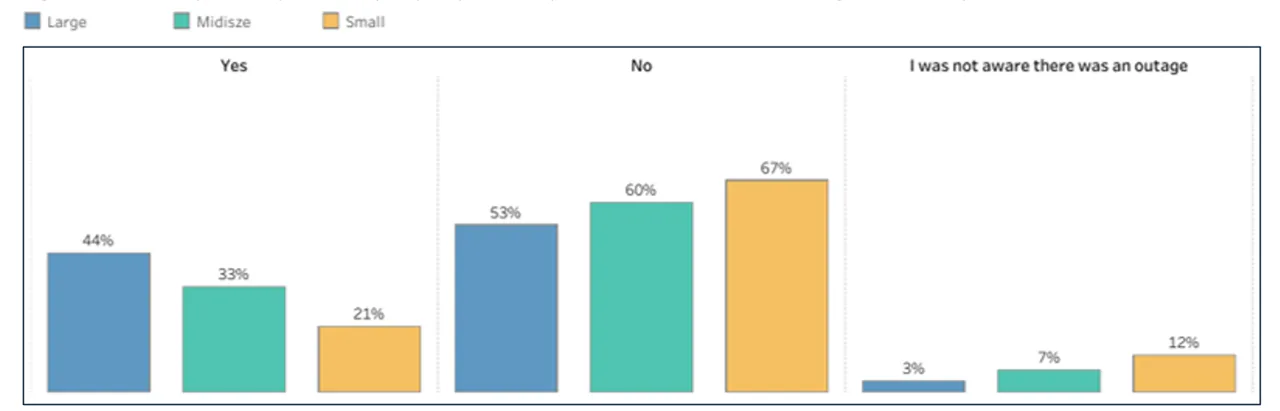
Large businesses reported the highest direct impact: 44% said the outage affected their company. Midsize companies came in at 33%. Small businesses sat at 21%. The remaining respondents in each segment indicated either no impact or were unsure. The gradient makes operational sense. Large organizations run more lines, more devices, more mission-critical workflows over wireless. A national field service operation or a distributed retail chain has thousands of points of exposure. A five-person shop has a handful. The outage hit large businesses hardest because they have the largest surface area. Large enterprises also operate more redundancy infrastructure, dedicated IT, secondary carrier contracts, Wi-Fi fallback. Whether the 44% figure reflects greater network dependency or greater issue-reporting sensitivity is not separable from this data.

The awareness data runs in the opposite direction. Among small businesses, 12% said they weren’t even aware an outage had occurred, compared to 3% of large enterprises and 7% of midsize. Small businesses run lean. If the phones worked well enough that day, or if the outage was brief enough in their geography, it didn’t register as a business event. Large enterprises have someone whose job is to know when the carrier goes down.

This awareness asymmetry matters for Verizon’s sales team. The enterprise segment felt the outage acutely and paid attention. That’s also the segment where Verizon has historically leaned on network reliability as its core value proposition. The pitch is that you pay more because the network doesn’t go down. January 14 complicated that pitch in the accounts where it matters most.

Figure 1: Was anyone in your company impacted by the Verizon Wireless outage of January 14th, 2026?

Source: Recon Analytics B2B Pulse, January 21st-February 25th, 2026. Percentages based on business respondents. Total n = 1,702, MoE = 2.4%; Large Business (1,000+ employees) n = 561, MoE = 4.1%; Midsize (20-999 employees) n = 538, MoE = 4.2%; Small Business (<20 employees) n = 603, MoE = 4.0%

Opinion Change Was Contained, Not Neutral

Among business customers who were aware of the outage, stated opinion change was limited. Across all size segments, roughly two-thirds said the outage did not change their opinion of Verizon. Opinion stability was statistically consistent regardless of company size.

The more operationally significant data is among those whose opinions did shift. Roughly 5-6% across segments said, “much more negative” and 27-29% said “somewhat more negative.” Combined negative sentiment ran approximately 32-35% across all segments. For an event that hit on a single day lasting about 10 hours, generating negative opinion change in roughly a third of aware business customers is a credibility problem if the narrative isn’t actively managed.

One caveat on the “no change” majority: it captures two distinct customer types that the data cannot separate. The first is the genuinely loyal customer who considers this within the bounds of acceptable carrier performance and has no intention of changing anything. The second is the customer who already held a neutral or negative opinion of Verizon before January 14, who are already at risk of leaving. Both sit in the same response bucket. The data cannot tell you how large each population is.

 Figure 2: (only if impacted by outage) How has the network outage changed your opinion of Verizon Wireless?

Source: Recon Analytics B2B Pulse, January 21st-February 25th, 2026. Percentages based on business respondents who indicated they were impacted by the outage. Total n = 551, MoE = 4.2%; Large Business n = 246, MoE = 6.2%; Midsize n = 179, MoE = 7.3%; Small Business n = 126, MoE = 8.7%

The Loyalty Question Is Where the Size Gap Becomes a Revenue Conversation

Because no pre-outage baseline is available for switching intent in this sample, the figures below represent a post-event snapshot, not a measured change from prior intent levels.

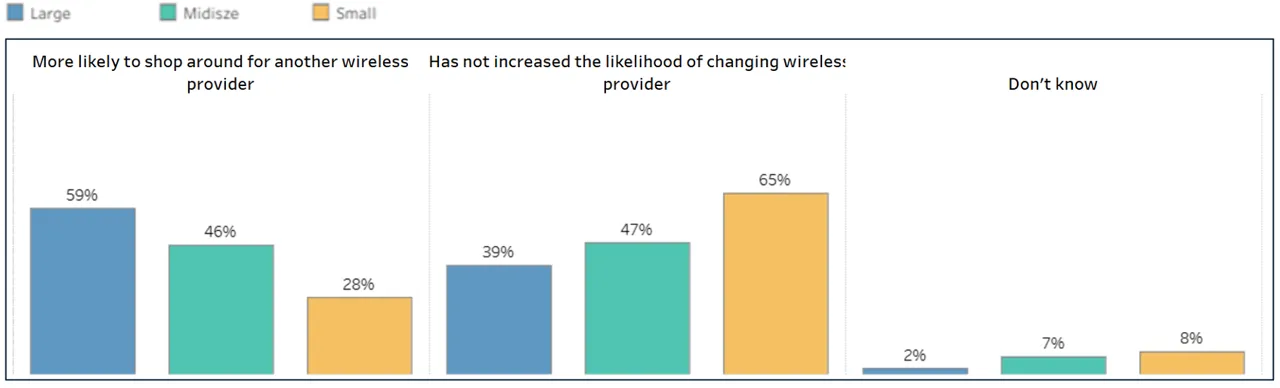
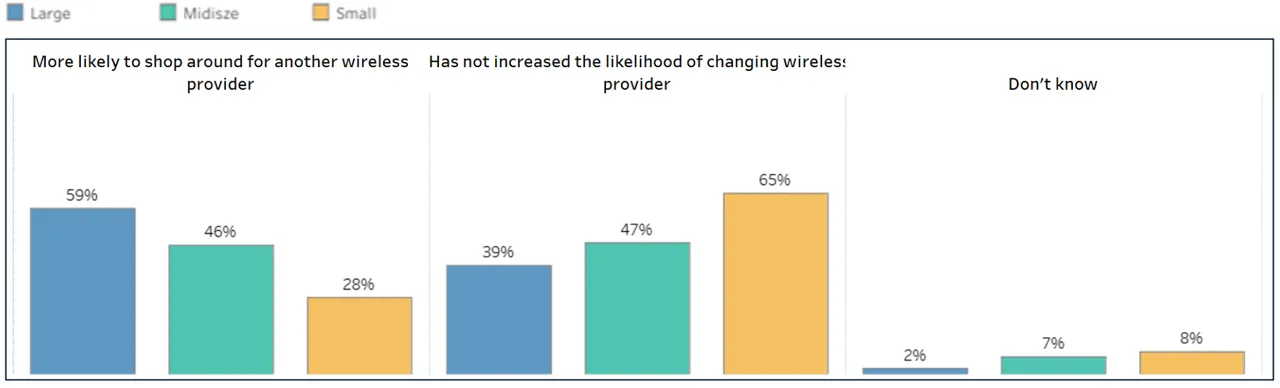
Among current Verizon Wireless business customers asked how the outage affected their likelihood of staying after their current agreement, small businesses were the most forgiving: 65% said the outage had not increased their likelihood of changing providers, 28% said they were more likely to shop around, and 7% were unsure or did not respond. Large businesses showed a different picture, with 39% saying the outage had not increased their likelihood of switching, 59% said they were more likely to evaluate alternatives, and 2% were unsure. Midsize was a statistical tie.

Among large business Verizon customers, 59% said the January 14 outage made them more likely to evaluate alternatives when their contract comes up. Remember, intent to shop is different from switching. Contract lock-in, device payoff schedules, multi-line complexity, and the operational headache of migrating a large business all create meaningful friction between stated intent and revealed behavior. Enterprise switching intent historically overstates eventual switching behavior. Even accounting for that gap, a post-event snapshot where 59% of large business Verizon customers express elevated interest in alternatives is a leading indicator that the competitive pipeline has expanded.

Enterprise wireless agreements typically run one to three years. The cohort of large accounts whose contracts expire in 2026 and 2027 is now at elevated churn risk compared to January 13. Verizon’s enterprise sales team should be in front of those accounts before AT&T and T-Mobile arrive with a pitch deck that opens on January 14.

 Figure 3: (currently using Verizon) How did the outage impact the likelihood of you staying with Verizon Wireless at your next renewal?

Source: Recon Analytics B2B Pulse, January 21st-February 25th, 2026. Percentages based on business respondents who self-reported current Verizon Wireless use. Total n = 510, MoE = 4.3%; Large Business n = 201, MoE = 6.9%; Midsize n = 167, MoE = 7.6%; Small Business n = 142, MoE = 8.2%

The Non-Verizon Market: Enterprise Forgives, Small Business Does Not

Among business customers not currently on Verizon, the outage produced differentiated responses that also track with company size.

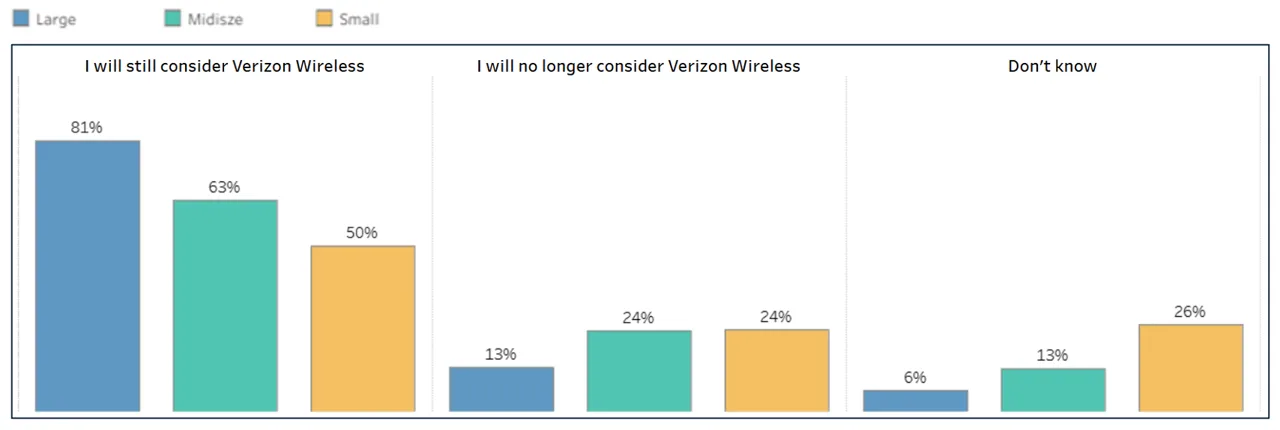
Large businesses remained the most open to Verizon despite the outage: 81% said they would still consider Verizon when their current agreement expires. One bad day doesn’t remove a major carrier from consideration. Enterprise procurement decisions involve pricing, coverage, device ecosystems, and account support infrastructure. Small businesses reacted more negatively to the outage, even though they did not experience the outage directly. 24% of small businesses said they would no longer consider Verizon, while 26% said they were unsure. A single outage is a data point, not a disqualifier, but can unbalance customers that are on the fence.

Figure 4: (Not currently using Verizon) How did the outage impact the likelihood of you considering Verizon Wireless next?

Source: Recon Analytics B2B Pulse, January 21st-February 25th, 2026. Percentages based on business respondents who do not use Verizon Wireless (self-reported). Total n = 1,064, MoE = 3.0%; Large Business n = 341, MoE = 5.3%; Midsize n = 334, MoE = 5.4%; Small Business n = 389, MoE = 5.0%

What Verizon Has to Do Now

The January 14 outage created a two-front problem. In the existing base, large business accounts are at elevated renewal risk. In the prospect market, small businesses have partially written Verizon off. But both are addressable.

Verizon’s enterprise team should prioritize proactive outreach to its large account base before those contracts expire. Generic reliability commitments won’t land. The message needs to be specific: what failed, what was fixed, what redundancy was added, what the SLA improvement looks like going forward. Enterprises don’t need apologies. They need engineering answers.

On the prospect side, the small business perception problem is harder because it’s driven partly by information Verizon doesn’t control. The counter-narrative has to reach small business decision-makers through channels they trust: peer networks, trade media, and the resellers and agents who carry Verizon’s products into that segment.

The January 14 outage was one bad day, which must be addressed with customers to protect accounts that could take years to win back if lost.


By Joe Salesky, Head of AI Research

Based on interviews with 193,266 Americans conducted between March 2025 and February 2026

A massive and largely quiet transformation is underway in the American workforce. Recon Analytics tracks AI adoption through weekly pulse surveys of over 300,000 respondents annually. The data reveals that 42% of employed AI users now direct those tools toward work tasks, generating an estimated $420 billion in annual productivity value. Only half of these workers say their adoption came through any formal company program. The other half found their own way.

The Workforce Picture

33% of employed Americans now use AI for work tasks. Among knowledge workers in financial services, professional services, scientific and technical fields, communications, media, law, healthcare, education, and government, the rate is 37%. Among employed people who already use AI in any capacity, 42% use AI tools in their jobs.

Workers Are Leading, Companies Are Following

Work AI users who answered questions about their adoption pathway (n=20,934 since July 2025), roughly half report either using AI independently or working at a company with no formal AI initiative. 20% say they adopted AI through a deliberate, self-directed choice with no company involvement at all; another 38% report their company has no formal AI initiative or they are unsure whether one exists. The workforce is pulling AI adoption forward while many organizations are still debating governance frameworks.

For those who can identify initiative drivers, executive leadership accounts for 33% and IT departments for 47%. These figures overlap because respondents can select multiple drivers. The gap between the 47% who credit IT and the 50% operating outside any formal program is a governance challenge.

Who Pays for AI

29% of work AI users pay for a premium subscription to their primary tool. Employer or team funding covered 40% of paid subscriptions in August 2025. That figure has climbed to 50% in February 2026. Corporate procurement is catching up, while half of all paid work AI subscriptions still come out of workers’ own pockets.

Workers spending $20-30 per month of their own money on AI tools they believe make them more productive, without being asked and often without their employer’s knowledge, is a revealed preference. These workers have already conducted the cost-benefit analysis that many enterprise procurement processes are still debating.

Retention Is Strengthening, Not Weakening

For work AI users on paid subscriptions, cancellation intent has declined steadily from 26% in August 2025 to 20% in February 2026. The trajectory is consistent: Four in five paid AI subscribers plan to keep paying.

A 20% cancellation rate in a product category barely two years old compares favorably to mature SaaS categories that typically see 25-35% annual churn in their first 18 months. The downward trajectory suggests that workers who survive the first few months of paid use are settling into habitual usage patterns. Paid AI has crossed from experiment to infrastructure.

The Productivity Signal

Among 18,117 work AI users surveyed over the last 90 days, 97% report at least one tangible benefit and 94% report measurable time savings. The top benefit is increased productivity and efficiency at 45%, followed by quick generation of actionable information at 34%, enhanced decision-making at 28%, and automated repetitive tasks at 24%.

Workers who report hours saved (n=16,154) average 6.3 hours per week. Some of AI’s productivity value does not register as “hours saved”, a developer who writes cleaner code the first time, a marketing analyst who produces three campaign variants instead of one, a sales rep who personalizes 50 outreach emails instead of sending one generic blast: none of these show up as recovered hours. They show up as better output. Self-reported time savings captures one dimension of a multi-dimensional productivity gain.

Based on 161.3 million employed Americans (BLS, 2024 annual average), with 33% using AI and 42% of those directing it toward work, approximately 22 million workers are using AI on the job. At the self-reported mean of 6.3 hours per week and BLS total compensation of $48.05 per hour for civilian workers (Employer Costs for Employee Compensation, June 2025), the annualized productivity value is approximately $340 billion. Adjusted for the occupational skew of AI work users toward professional, technical, and financial roles that carry above-average compensation, the estimate reaches approximately $420 billion in annual productivity value.

What This Means

For enterprise IT leaders, internal AI adoption metrics almost certainly undercount actual usage. Dashboard-tracked deployments of Copilot, Gemini for Workspace, or other enterprise-licensed tools capture only the formal channel. Workers using personal ChatGPT Plus, Claude Pro, or Perplexity subscriptions on their own devices are invisible to those dashboards. The opportunity is to channel demonstrated demand into governed platforms.

For AI platform vendors, employer-funded subscriptions grew from 40% to 50% of paid work AI users in six months. That trajectory points toward corporate procurement absorbing what workers started on their own. The conversion trigger for free users considering paying is integration with existing productivity applications: Microsoft 365, Google Workspace, Salesforce. Prior reports have noted that Enterprise data infrastructure expansion will clearly grow both enterprise paid usage and business impact.

The comprehensive report providing deeper analysis, conclusions, and recommendations is available on ReconAnalytics.com.


Methodology: Recon Analytics AI Pulse Survey. Continuous weekly data collection, March 2025 to present. Total respondents: 193,266 (n=16,154 for hours-saved analysis, last 90 days). Monthly sample sizes range from 944 (March 2025, early panel) to 34,253 (October 2025, full panel). Quality controls reject unqualified responses at 4-10x the industry standard. Productivity value calculation: BLS Employer Costs for Employee Compensation (ECEC), June 2025 release, civilian workers total compensation $48.05/hour; BLS Current Population Survey, 2024 annual average, 161.3 million employed.

Contact: [email protected]

AI Revenue: Paid Adoption Requires Data, Not Better Models

February 17, 2026 | Joe Salesky, Analyst & Head of AI Research


Eight breakthrough model releases in seven months produced four percentage points of daily usage growth. 75% of Americans have tried AI, but only 25% use it daily. The bottleneck is not intelligence. It is trust and context. Privacy scores -30 cNPS across the entire AI ecosystem, the lowest attribute by 28 points, based on more than 120,000 respondents surveyed over 38 weeks. Users who connect AI to their private data convert to paid subscriptions at 3x the rate of those performing basic tasks. The model capability race has hit diminishing returns. The next phase belongs to whoever solves the data infrastructure problem for consumers and enterprise.

The 50-Point Gap Between Trial and Habit

Three out of four Americans have tried an AI tool. One in four uses it daily. The 50-point spread between trial (76%) and habitual use (26%) is not a marketing problem. It is a utility problem.

The middle of the funnel defines the conversion opportunity. 19% of respondents use AI weekly, suggesting it occupies a place in their routine but has not become essential. Another 10% use it monthly. Combined with the 21% who tried AI and walked away, these cohorts represent half the population: consumers who engaged with AI and did not find sufficient value to stay.

The demographic surprise: Millennials, not Gen Z, are the heaviest users. Daily usage peaks in the 30-44 age bracket at 36%, five points ahead of 18-to-29-year-olds at 31%. The explanation is context and compensation. Mid-career knowledge workers face more tasks that align with AI capabilities. The inflection arrives at 60, where daily usage drops to 11%. Seniors have not rejected AI. Nobody has shown them what it can do.

Privacy Is Both the Lock and the Key

45% of Americans remain outside the AI economy. Among those who have never tried AI, 44% cite lack of interest, 25% cite ethical concerns, and 24% cite distrust of AI answers. Cost ranks last in both the never-tried and tried-and-quit segments. Only 5-9% cite expense as a barrier. Free versions exist for every major platform. Price is not the obstacle.

Privacy is the top barrier and the top motivator. 21% of never-tried respondents say knowing their data would be safe and private would motivate them to try AI, the only response exceeding 20%. The same consumers who say they do not trust AI say privacy assurance would bring them in. This is not a contradiction. It indicates that trust is the gate through which new users must pass.

Among active users, the picture is worse. Privacy scores -30 cNPS, nearly 28 points below complete experience (-2). Every platform in the dataset reports negative privacy cNPS, from Perplexity at -18 to Meta AI at -43. Zero for twelve. Apple Intelligence scores -25, underperforming its privacy-centric brand positioning. Payment helps: paid users report -9 versus -34 for free users, a 25-point lift. But no platform achieves positive territory.

ChatGPT Dominates. Satisfaction Tells a Different Story.

ChatGPT leads primary platform selection at 50%. Google Gemini follows at 20%. Microsoft CoPilot (8%), Apple Intelligence (6%), and Meta AI (6%) form a competitive middle tier. The top four platforms represent 83% of primary selections.

Scale inversely correlates with satisfaction among free users. Perplexity, at less than 1% share, posts cNPS of +8. ChatGPT, at 48% of free users, registers -1. Google Gemini scores -6. The pattern is monotonic: larger user base, lower satisfaction. Smaller platforms attract self-selected enthusiasts who chose the tool deliberately. Larger platforms accumulate casual users through distribution advantages and brand awareness.

Paid users report higher satisfaction across every platform without exception. The aggregate cNPS gap: +18 for paid versus -7 for free, a 25-point differential. ChatGPT moves from -1 to +25. Payment is not a gamble. It is a reliable upgrade across the board. The challenge is getting users past the trust barrier to that first payment.

The 3x Conversion Divide

The use case hierarchy is steep. Web search leads adoption at 43%, followed by writing assistance at 33% and topical research at 26%. These information retrieval tasks require no private data, no account connections, no infrastructure beyond the prompt itself. Transformation use cases cluster at the bottom: data analysis at 20%, coding at 9%, automation at 9%.

The conversion gap tells the real story. Coding assistance converts at 41% to paid subscriptions. Automation follows at 37%. Data analysis converts at 31%. Information use cases trail: web search at 17%, topical research at 21%. The 2x gap between transformation and information use cases is not about features. Both tiers offer the same use cases. This is about user profile. Users who need transformation already have infrastructure that makes AI valuable.

Crossing work context with subscription status creates four segments with dramatically different satisfaction profiles. Work + Paid users report productivity cNPS of +23. Home + Free users report -20. The 43-point gap defines the challenge for consumer AI. A Home + Paid user (-1) is no more satisfied than a Work + Free user (-1). Work context provides more satisfaction improvement than payment alone. The difference between +23 and -1 is the combination of subscription plus infrastructure, not the subscription by itself.

The Second Inning Is About Data, Not Models

Data-dependent users, the 18% who employ AI for data analysis or automation, report productivity cNPS of +9 versus -13 for non-data users. They show 61% daily usage versus 28%. They convert to paid at 32% versus 9%, a 3x advantage. This minority demonstrates the engagement and monetization patterns every platform seeks. When users connect AI to their private data, they use it more, value it more, and pay for it more.

The entities with access to private data are not primarily AI companies. Apple holds photos, messages, health data, and financial transactions for over a billion users. Google holds Drive documents, Gmail archives, and location history. Microsoft holds OneDrive files and Outlook correspondence. These companies have the Organize and Unify layers that AI platforms lack. The strategic landscape creates natural partnership opportunities: AI platforms have models but need data access; device and cloud providers have data but need AI differentiation.

The shift is from “ask me anything” to “help me with my data.” The former is a party trick that saturates quickly. The latter is a utility that compounds with use. The stronger engine is ready. It needs better tires for traction.


Report Details

Genius Myopia: Why Smarter Models Aren’t Enough

How Trust and Context Unlock the Next Stage of Adoption | March – December 2025

The complete 23-page report includes detailed analysis of:

  • Usage frequency distribution and demographic breakdowns across age and income segments
  • Barrier analysis for the reluctant 45%, including never-tried and tried-and-quit segments
  • Platform-by-platform market share, satisfaction, and subscription dynamics
  • The O/U/T Framework: Organize, Unify, Transform as the value creation model for consumer AI
  • Connectivity as infrastructure proxy: fiber converts at 2x the rate of cable for paid AI
  • Privacy cNPS across all twelve platforms and the payment improvement effect
  • The Second Inning Playbook for AI Platforms, Device OEMs, Cloud Providers, and Investors

📊 View Report Details & Purchase →

For licensing inquiries: [email protected]


AI Choice 2026: Why Licenses Don’t Equal Adoption

February 3, 2026 | Joe Salesky, Analyst & Head of AI Research


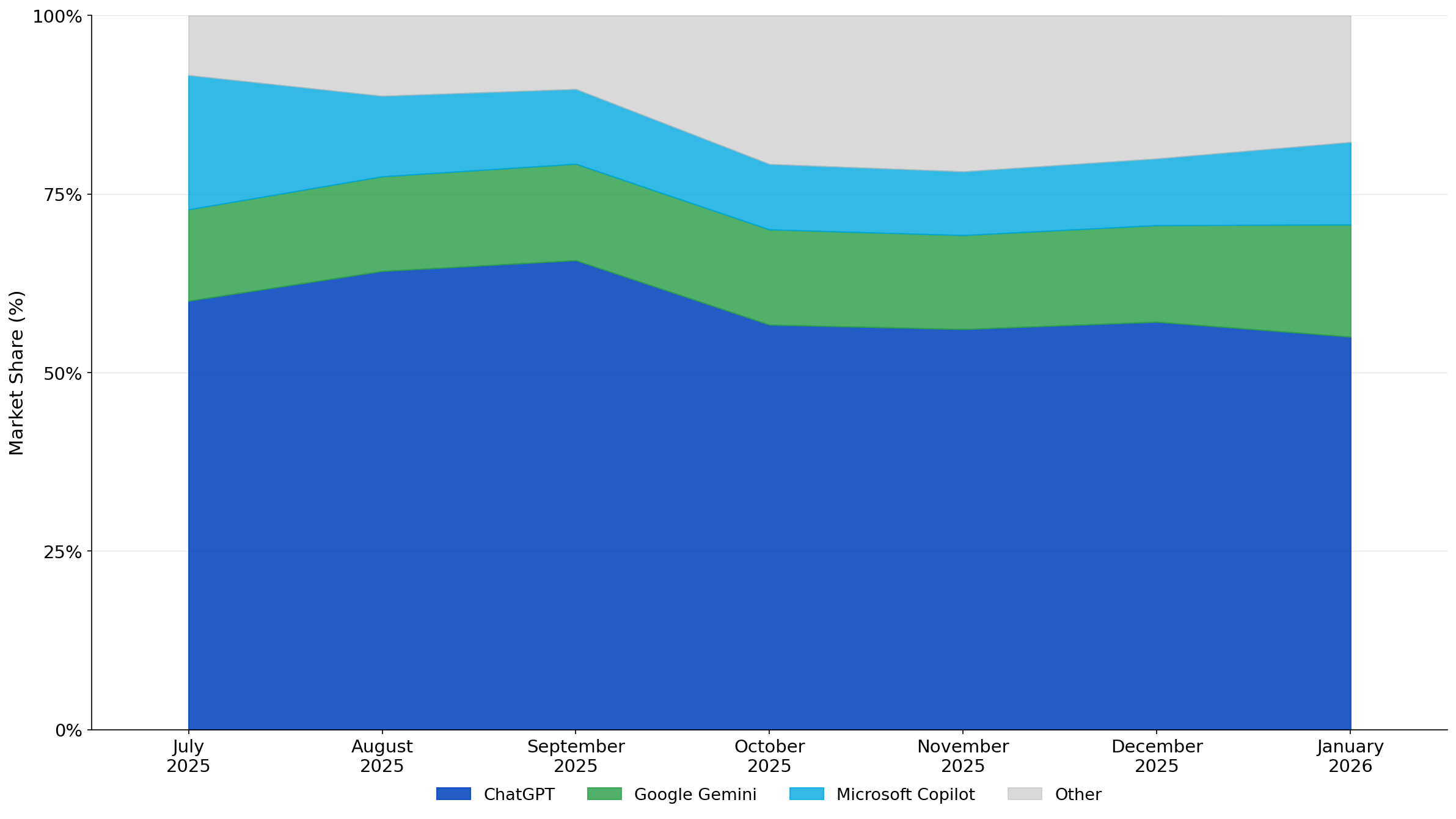
Despite Microsoft’s enterprise distribution advantages and Office 365 integration, Microsoft Copilot lost 7.3 percentage points of paid subscriber share in seven months while Google Gemini gained 2.9 points, based on more than 150,000 respondents. Distribution advantages do not lock in market position. Employees receiving enterprise AI tools evaluate options and select based on experience. The platform that delivers the most reliable results wins, regardless of vendor seat licenses.

The 39% Market Contraction

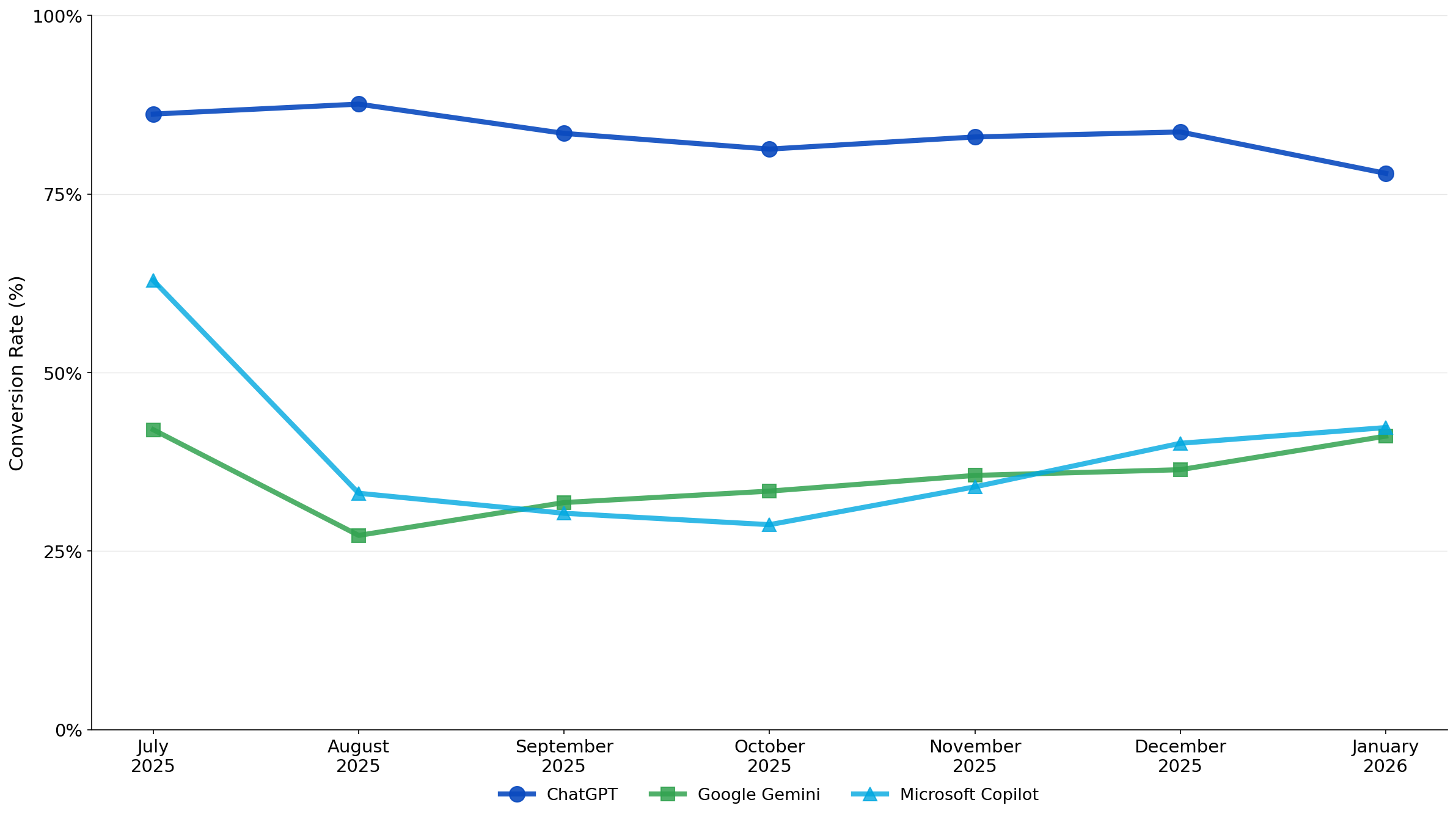
Copilot’s decline from 18.8% in July 2025 to 11.5% in January 2026 represents a 39% contraction in market position among U.S. paid AI subscribers. This occurred during a period when Microsoft actively invested in enterprise distribution and deepened Office 365 integration. The platform accesses the same OpenAI models as ChatGPT, so underlying capability is comparable. The divergence in user perception points to product experience and integration execution rather than model quality.

ChatGPT maintained dominant share near 55.2% with modest erosion from 60.7% in July. Gemini climbed from 12.8% to 15.7%, crossing Copilot in late November to claim the number-two position. The two platforms now separated by more than 4 percentage points, with Gemini’s trajectory continuing upward while Copilot stabilized in the 10-12% range.

Exhibit 1: Primary Platform Share Among U.S. Paid AI Subscribers


Source: Recon Analytics U.S. AI Survey, July 2025 – January 2026. U.S. paid subscribers only.

The Workplace Conversion Gap

When Copilot is the only AI platform an employer provides, 68% of workers adopt it as their primary tool. This demonstrates meaningful uptake when alternatives are absent. The competitive dynamics shift when employers offer multiple platforms.

Among workers with both Copilot and ChatGPT available, Copilot’s adoption falls to 18% while ChatGPT captures 76%. When all three major platforms are available, only 8% choose Copilot while 70% choose ChatGPT and 18% choose Gemini. The pattern is consistent: as worker choice expands, Copilot adoption collapses.

ChatGPT converts 83.1% of U.S. paid subscribers who have workplace access. Copilot converts 35.8%. Gemini converts 34.0%. The 47-point gap between ChatGPT and Copilot quantifies the adoption challenge. Microsoft’s Office 365 distribution creates exposure. That exposure does not automatically translate to preference when workers evaluate alternatives.

Exhibit 2: Workplace Conversion Rates by Platform


Source: Recon Analytics U.S. AI Survey, July 2025 – January 2026. Workers with paid AI subscriptions only.

Quality Perception Drives Share Movement

Gemini’s rise correlates with quality leadership. The platform posts the highest accuracy satisfaction scores among major competitors, 23 points above Copilot and 9 points above ChatGPT. Copilot’s decline correlates with the lowest accuracy perception in the market. Quality drives share movement, not deployment volume.

Copilot’s accuracy NPS remained persistently negative throughout the measurement period. July showed -3.5, September declined to -24.1, and January finished at -19.8. The gap is not closing. Users who tried Copilot and stopped using it cited distrust of answers at 44.2%, exceeding comparable figures for Gemini (42.8%) and ChatGPT (40.6%).

The correlation between accuracy perception and market share movement is direct. Platforms investing in quality gain share. Those relying on ecosystem integration without matching quality lose share.

The Enterprise Market Remains Contestable

Multi-platform enterprise deployment is common. Among U.S. paid subscribers with Copilot available at work, over half also have ChatGPT available. Workers evaluate options and select based on experience rather than defaulting to whatever platform their employer provisions.

The enterprise AI market is not winner-take-all. Every renewal cycle presents an opportunity for challengers to displace incumbents based on demonstrated superiority. Microsoft’s enterprise dominance in productivity software does not foreordain Copilot’s dominance in AI. Google’s Workspace position does not guarantee Gemini’s success. The platforms that execute on accuracy, integration, and use case demonstration will capture enterprise spend in 2026.

ChatGPT’s 83.1% workplace conversion rate and 55.2% market share reflect entrenched product-market fit. Competitors are not displacing ChatGPT. They are competing for second position. Gemini demonstrated that share can shift when product experience improves. Copilot demonstrated that share can decline when it does not.


Report Details

User Illusion: Licenses Don’t Equal Adoption

U.S. Paid AI Subscriber Market Analysis | July 2025 – January 2026

The complete 24-page report includes detailed analysis of:

  • Platform-by-platform strategic implications for Microsoft, Google, and OpenAI
  • Use case performance across web search, research, writing, coding, and data analysis
  • NPS trajectories showing accuracy perception trends over seven months
  • Churn intent and retention dynamics by platform
  • Investment theses for enterprise AI market positioning

📊 View Report Details & Purchase →

For licensing inquiries: [email protected]


On January 16, 2026, OpenAI announced plans to test advertisements in ChatGPT’s free tier and the new $8/month “Go” tier in the United States. The move was widely anticipated: advertising funded the scaling of Google Search and Facebook and has been expected as the monetization path for consumer AI services. With OpenAI reportedly losing over $11.5 billion in Q3 2025 and projecting infrastructure spending of $1.4 trillion over the next eight years, the decision reflects economic necessity rather than strategic pivot.

Our analysis of 117,467 U.S. consumers from the Recon Analytics US_AI Survey reveals the consumer dynamics underlying this decision—and the structural challenges that limit OpenAI’s advertising ambitions.

Metric Finding Implication
Free users unwilling to pay 40% Logical ad audience
Ads as switch trigger 31.6% Monitor for churn
NPS impact if ads added -50% likelihood Implementation matters

Source: Recon Analytics US_AI Survey, May-December 2025; n=117,467

The Monetization Logic

ChatGPT commands 48.5% usage share in the U.S., far ahead of Google Gemini at 18.5%. Only 22.3% of ChatGPT users pay for the service, creating a substantial free user base where advertising represents incremental revenue that would otherwise not exist. Among free users, 40% indicate they would never pay for AI services at any price point. For this segment, advertising is the only viable monetization path.

Platform Share Paid Rate Has Ads
ChatGPT 48.5% 22.3% Coming Soon
Google Gemini 18.5% 12.5% No Plans
Microsoft Copilot 8.0% 27.4% No
Claude 4.3% 35.7% No

Source: Recon Analytics US_AI Survey, May-December 2025; n=117,467

Pioneer’s Peril: The Competitive Reality

OpenAI faces what we term “Pioneer’s Peril”: being first to test AI advertising while helping incumbents refine their approach. Google and Meta will defend aggressively. Advertising represents 77% and 97% of their respective revenues, totaling approximately $456 billion in 2025 and controlling roughly 50% of the global digital ad market. Both already deploy AI-powered ad tools. Google’s Performance Max and AI Max deliver 14% average conversion lifts; Meta’s Advantage+ shows 22% ROAS improvements. The six major agency holding companies control approximately 30% of U.S. ad spend with established workflows and proven ROI benchmarks. Switching costs are material—not technical, but institutional.

Digital advertising already represents 82% of total ad spend globally. OpenAI cannot rely on a secular shift from traditional media; that transition is complete. Any meaningful revenue must come from the existing $777 billion digital pool. Capturing even 1% ($7.8 billion) would require displacing entrenched competitors with superior targeting, measurement, and advertiser relationships that do not yet exist.

User Sentiment: A Window of Opportunity

Ads rank last among current user concerns at just 2%, well below privacy (27%) and job displacement (29%). Users have not yet formed strong negative associations with AI advertising. Whether this remains true depends entirely on implementation quality. Nearly one-third of users (31.6%) indicate ads could trigger them to switch platforms, suggesting that intrusive or poorly executed advertising could accelerate competitive dynamics in a market where switching costs are minimal.

Concern % Citing
Job displacement 29%
Privacy 27%
Accuracy of responses 18%
Bias in AI 12%
Ads / sponsored content 2%

Source: Recon Analytics US_AI Survey; n=117,467

OpenAI’s decision to introduce advertising in the free tier follows sound business logic for user monetization. With 40% of free users indicating they will never pay, advertising represents the only viable revenue path for this segment. However, building a material advertising business faces structural headwinds. Google and Meta’s entrenched positions, AI-powered ad tools, and deep agency relationships create formidable barriers. The most likely near-term outcome is that ChatGPT advertising generates incremental revenue from the free tier but struggles to capture meaningful share of advertiser budgets from platforms with proven performance. We expect modest revenue contribution in 2025-2026, with OpenAI’s advertising ambitions likely measured in hundreds of millions rather than billions.

Methodology: Data from Recon Analytics US_AI Consumer Survey. Fielded May 1 – December 5, 2025. Total sample: n=117,467. Margin of error: ±0.3% at 95% confidence.